
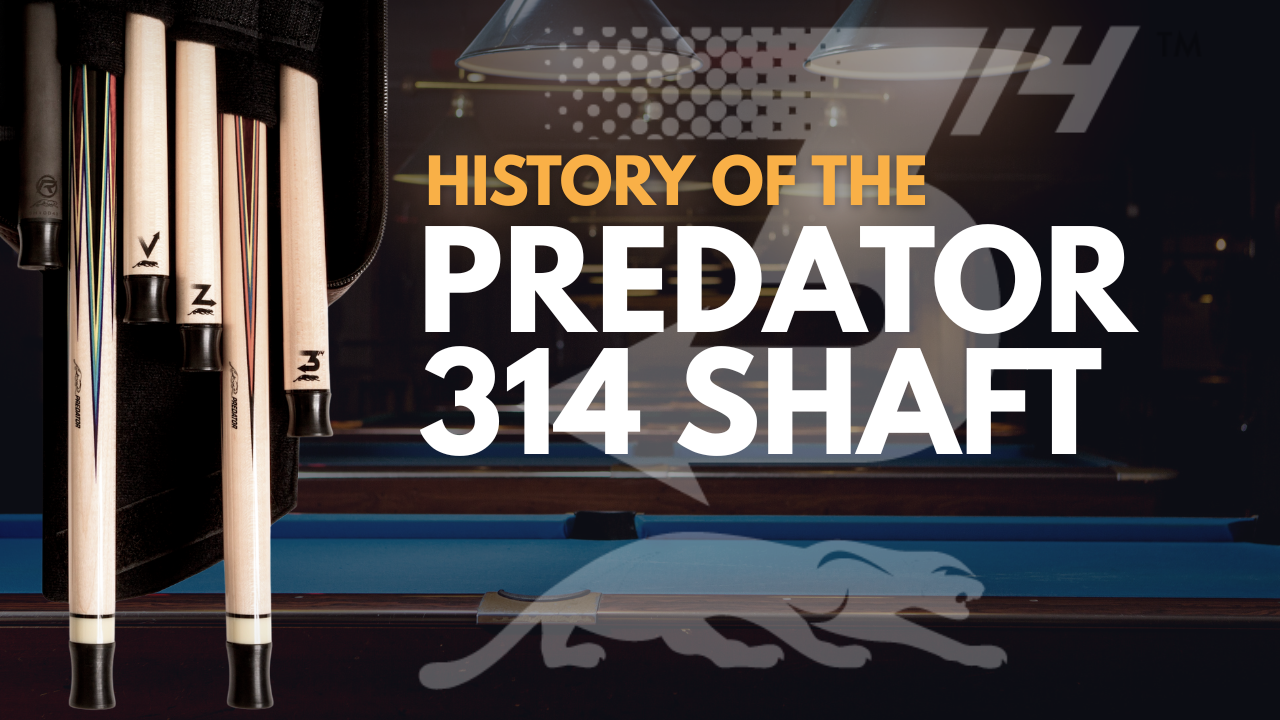
How Predator Changed Billiards Forever
The 314 Shaft Story
For over a century, serious pool players accepted one unavoidable reality. If you wanted spin, you had to compensate. Off center hits caused the cue ball to deflect away from the target, forcing players to aim off the pocket and hope their adjustment was correct. This phenomenon became known as deflection, and it shaped how the game was played for generations.
In the mid 90s, everything changed.
A new cue company stopped treating cues as decorative objects and began engineering them as performance instruments. That company was Predator Cues, and the shaft that reshaped the sport was called the 314.
This is the story of how one piece of engineering permanently altered the game of pool.
The Problem Predator Set Out to Solve
Before Predator, pool was a game of feel, experience, and compensation. When a player applied English by striking the cue ball off center, the shaft would resist the impact and push the ball off its intended line. Every shaft behaved differently. Grain patterns, humidity, taper, and rotation all influenced the result.
Players were not just mastering their stroke. They were learning to guess how their equipment would react.
Predator questioned that assumption. Instead of asking how players should adapt to deflection, they asked a more fundamental question. What if the cue did not fight the player at all.
The Birth of the 314 Shaft
Predator was founded in nineteen ninety four by Allan McCarty and Steve Titus. Their breakthrough did not come from tradition or intuition. It came from testing.
They built a robotic stroking machine known as Iron Willie. This machine delivered the same stroke, speed, and contact point repeatedly. By removing human inconsistency, Predator was able to isolate the true source of deflection.
The culprit was end mass.
The heavier the front of the shaft, the more it pushed the cue ball off line during off center contact. Predator responded by removing mass from the front of the shaft, creating the world’s first widely adopted low deflection shaft.
That decision changed everything.
Why It Is Called the 314
The name 314 is not marketing. It is mathematics.
Traditional shafts are made from a single piece of maple. This creates a natural spine with a stiff side and a soft side. Rotate the cue and the hit changes. Consistency depends on orientation.
Predator eliminated this issue by cutting maple into ten equal wedges, each separated by thirty six degrees, and laminating them into a perfectly radial structure. The result was a shaft with no spine and no preferred direction.
The hit remains the same regardless of rotation.
This was not craftsmanship for appearance. This was calculus applied to billiards.
The Pre Cat Era and the Canadian Connection
The earliest 314 shafts were produced before Predator introduced its cat logo. These pre cat shafts are now legendary among players.
Many of the early blanks were sourced from dense Canadian maple, including old growth wood that is extremely difficult to obtain today. Players often describe the hit as a solid thud with no hollow feedback or excessive vibration.
That sound and feel marked the moment Predator quietly changed the sport forever.
How Low Deflection Actually Works
Low deflection is not magic. It is physics.
By removing mass from the front of the shaft, Predator reduced resistance during off center contact. When the cue ball is struck with spin, the shaft moves out of the way instead of pushing the ball off line.
The result is less compensation, more natural aiming, and greater confidence using English. Instead of fighting physics, players allow physics to work in their favor.
The Evolution of Predator Shafts
Predator did not stop with the 314. They refined and expanded the platform to meet different playing styles.
The 314 became the all around benchmark. Forgiving, familiar, and precise.
The Z shaft introduced a thinner profile with even lower deflection, offering surgical precision for players who demand extreme control.
The Vantage shaft moved in the opposite direction, providing a thicker and stiffer option for power players who still wanted advanced engineering benefits.
Each of these shafts traces its DNA directly back to the original 314.
REVO and Centro
The Modern Predator Era
Predator’s next major leap was REVO, a carbon fiber shaft designed for maximum consistency. It eliminated warping, delivered ultra low deflection, and maintained performance across all conditions.
Some players embraced it immediately. Others missed the organic feel of wood.
Predator responded by creating Centro. A hybrid design that blends the feel of wood in the hand with carbon fiber reinforcement at the front. Foam damping manages vibration, preserving feedback without sacrificing performance.
Centro represents modern engineering without abandoning the emotional connection players have with traditional cues.
Why This Still Matters Today
At Spot On Billiards, performance engineering matters. Equipment should work better, not just look better.
A Predator shaft is not about brand recognition. It is about removing variables and increasing consistency.
Spot On Billiards is an Authorized Predator Repair Centre, providing factory level ferrule work, cue maintenance, and precision repairs. Just as a performance car deserves certified service, high performance pool equipment deserves expert care.
Closing Thoughts
The 314 did more than introduce low deflection. It introduced standardization to a sport built on guesswork.
From the pre cat era to carbon fiber REVO and the hybrid innovation of Centro, Predator did not change pool by accident. They engineered it.
If you want to experience that difference, you know where to find us.
On behalf of the team at Spot On Billiards, we look forward to seeing you in the shop.
Share:
The Importance of Proper Cue Maintenance and Care
A Complete Guide to Heyball (Chinese 8-Ball)